
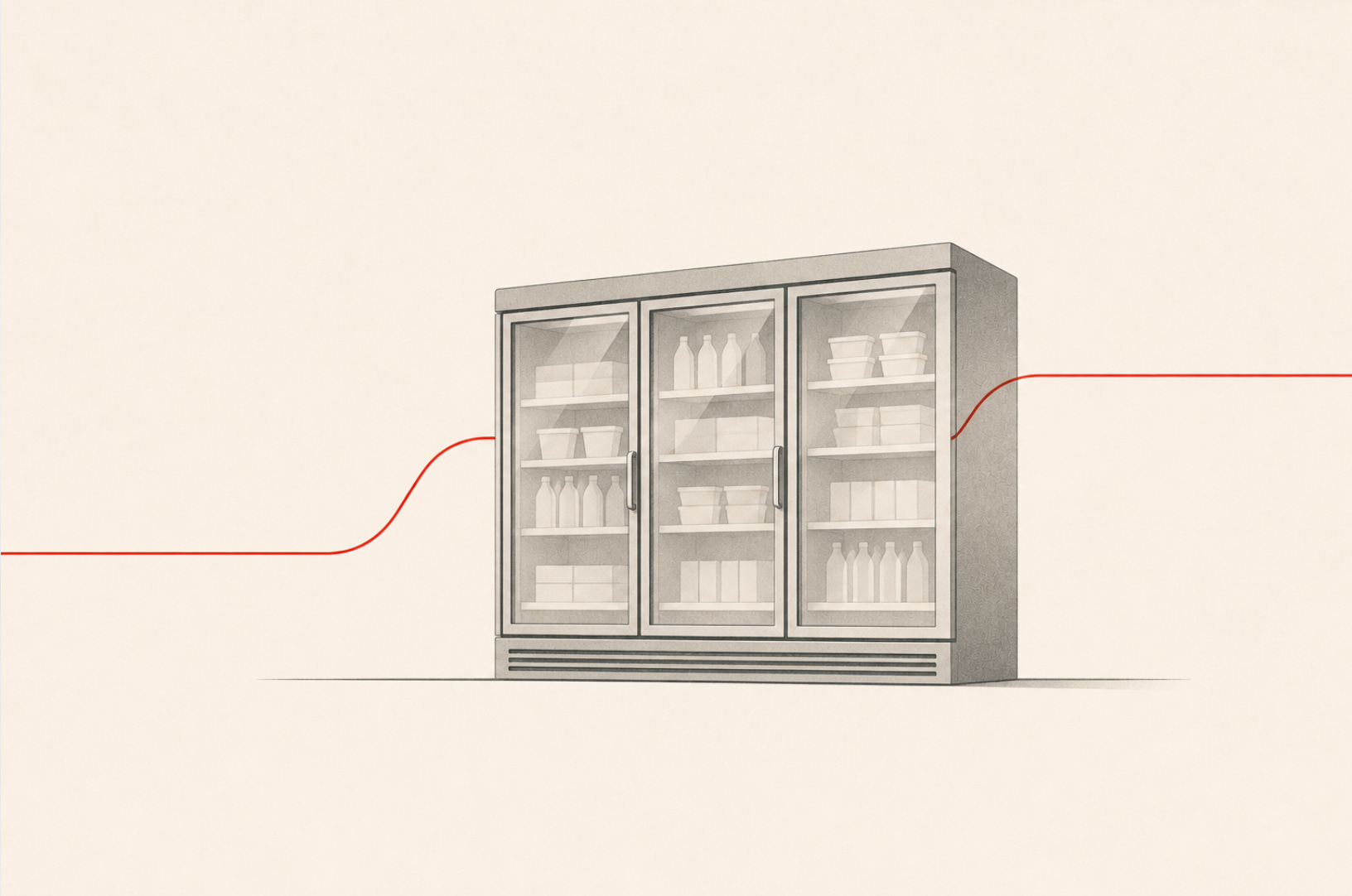
The modern supermarket has acquired a surprising new vulnerability. Its refrigerators are connected systems, and the software that keeps food cold can become a target for criminals operating nowhere near the shop.
On 3 November, Reuters reported that a cyberattack affecting refrigeration systems across Europe had also reached Italy. The Italian government said the domestic impact was extremely limited and that no public-health risk from thawing food had been identified.
That distinction matters. A cyberattack does not automatically produce a food-safety emergency. Officials described a small number of affected Italian outlets, mostly equipped with outdated security systems. Investigations were underway, while authorities continued monitoring the situation.
Elsewhere in Europe, the consequences were more visible. Some retailers had to discard refrigerated or frozen products after temperature-control systems were disrupted. The attackers’ identities and motives had not been established.
The incident is instructive precisely because it concerns such an ordinary piece of equipment. When people imagine digital risk, they tend to picture banks, hospitals, government databases or personal information stored on smartphones.
But refrigeration, logistics, heating, lighting and inventory systems increasingly depend on networked controls. The same connectivity that enables remote monitoring, preventative maintenance and energy efficiency can expand the number of places where something might go wrong.
For food retailers, resilience is therefore not confined to installing antivirus software on office computers. It includes knowing which suppliers maintain connected equipment, how security updates are delivered, who can remotely access controllers and what employees should do when digital systems fail.
A practical emergency plan may be just as important as an expensive security platform. Can temperatures still be checked manually? Can damaged stock be isolated? Can a shop continue operating safely while its equipment is disconnected?
There is a wider economic dimension. Large retail chains may employ specialist security teams, but smaller operators often inherit equipment, maintenance contracts and technical systems whose vulnerabilities are difficult to evaluate.
According to the Italian government’s preliminary assessment, many outlets had up-to-date protection, while affected premises tended to rely on obsolete systems, internet-exposed interfaces or inadequate authentication mechanisms.
That is encouraging, but it does not mean the entire food distribution network is immune. Cybersecurity is not a certificate obtained once and displayed forever. It is an ongoing responsibility shared by manufacturers, software suppliers, retailers and the people maintaining the equipment.
Europe has spent years discussing digital sovereignty in terms of cloud computing, artificial intelligence and strategic technology. The supermarket case offers a less glamorous definition: the ability to keep essential services running when connected systems are attacked.
Sometimes the test of a sophisticated digital economy is whether the frozen peas remain frozen.
THE ITALIC VIEW
The most revealing technology stories are often the least glamorous. Nobody goes shopping to admire a refrigerator’s cybersecurity policy. Yet the digital economy now reaches into places where failure has immediate, physical consequences.
Italy appears to have escaped major disruption this time. The lesson is not to disconnect every freezer. It is to remember that a connected appliance is also a system somebody must secure.