
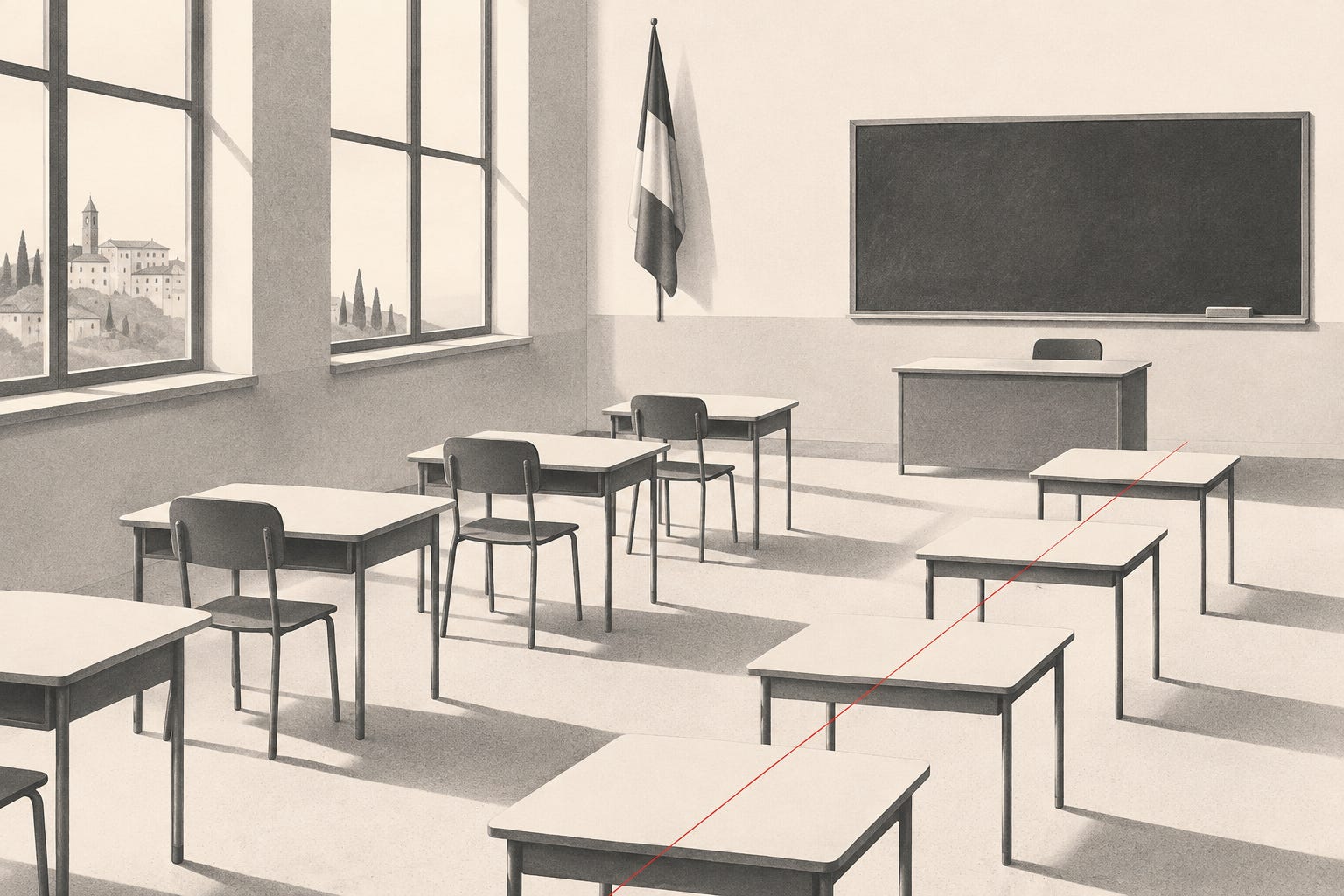
As Italy prepares to eliminate nearly 7,000 school posts, its demographic crisis raises a more difficult question: should fewer children mean less education spending, or better education for those who remain?
Italy has been worrying about its disappearing children for years. The debate usually concerns future pensions, labour shortages and the long-term sustainability of public finances. Now the demographic crisis is reaching a more immediate destination: the classroom. And the government’s response suggests that the consequences of having fewer children may be felt by those still attending school.
According to Reuters, reporting on 2 November, Italy’s draft 2027 budget proposes eliminating 4,925 teaching positions and 2,049 administrative, technical and auxiliary posts from the 2027–28 academic year. The reductions would follow earlier cuts introduced under the 2025 budget, bringing the cumulative reduction planned over three school years to 14,808 positions.
The demographic argument is difficult to dispute. Italy’s primary and secondary school population fell from approximately 8.4 million pupils in 2017–18 to 7.7 million in 2024–25. A school system serving fewer pupils must eventually reconsider how its resources are distributed. Maintaining every organisational arrangement indefinitely is neither necessarily efficient nor automatically beneficial to students.
Yet the relationship between declining enrolment and educational quality is considerably less straightforward than the budget calculations suggest.
The proposed school staffing reductions are expected to generate savings of approximately €83.9 million in 2027 and €251.7 million annually from 2028, according to the budget’s accompanying technical estimates. Those figures should not be confused with the separate, broader savings associated with restrictions on replacing retiring public employees.
The government has defended its overall record on education. Speaking in Parliament on 4 November, Education Minister Giuseppe Valditara argued that the administration had increased structural resources for schools, expanded recruitment and invested substantially in school buildings. He also pointed to measures intended to preserve educational provision in disadvantaged and sparsely populated areas.
These are relevant considerations. Staffing numbers alone cannot describe the quality of an education system, and a decline in pupil numbers does not justify preserving every existing position without examining changing needs. Public money must be used effectively, particularly in a country facing persistent fiscal constraints.
But the opposite assumption is equally questionable: that a smaller student population should naturally produce a proportionately smaller educational workforce.
Demographic decline could create an opportunity to address problems that have long affected Italian schools. Smaller classes might allow more individual attention, while additional support could improve learning outcomes and inclusion. In some communities, maintaining a school with relatively few pupils may be expensive in narrow accounting terms but valuable when its wider social role is considered.
This geographical dimension is particularly important.
In a large city, declining enrolment may permit schools to reorganise without fundamentally changing access to education. In a mountain municipality or a shrinking inland community, the disappearance of a class or the weakening of a school can influence whether families decide to remain. The consequences extend beyond education, affecting transport, employment, property markets and the viability of everyday local life.
The issue reached Parliament on 4 November, when representatives raised concerns about the impact of staffing reductions on communities already experiencing depopulation. The official parliamentary record shows how the dispute has evolved beyond trade-union demands into a broader argument about the distribution of public services.
There is a legitimate discussion to be had about how many teachers Italy needs, how resources should be allocated and whether existing staffing arrangements deliver adequate results. The answer cannot simply be that every reduction is harmful. Nor can it be that demographic decline automatically makes every reduction sensible.
What matters is whether savings are accompanied by measurable improvements in educational provision, or whether the system simply becomes smaller alongside the population it serves.
Italy’s declining birth rate is a structural problem. Its response to that decline remains a political choice.
THE ITALIC VIEW
There is something distinctly Italian about spending years warning that the country is running out of children, only to discover that fewer children might also provide an opportunity to spend less on schools. The arithmetic is understandable. The educational philosophy deserves closer examination. A smaller generation could receive more attention, better teaching and stronger support, particularly in communities where the school is one of the last remaining public institutions. Instead, the discussion risks becoming another argument about the cost of maintaining what exists. Perhaps the real question is not how many teachers Italy can afford to lose, but what kind of education it can afford to provide.