
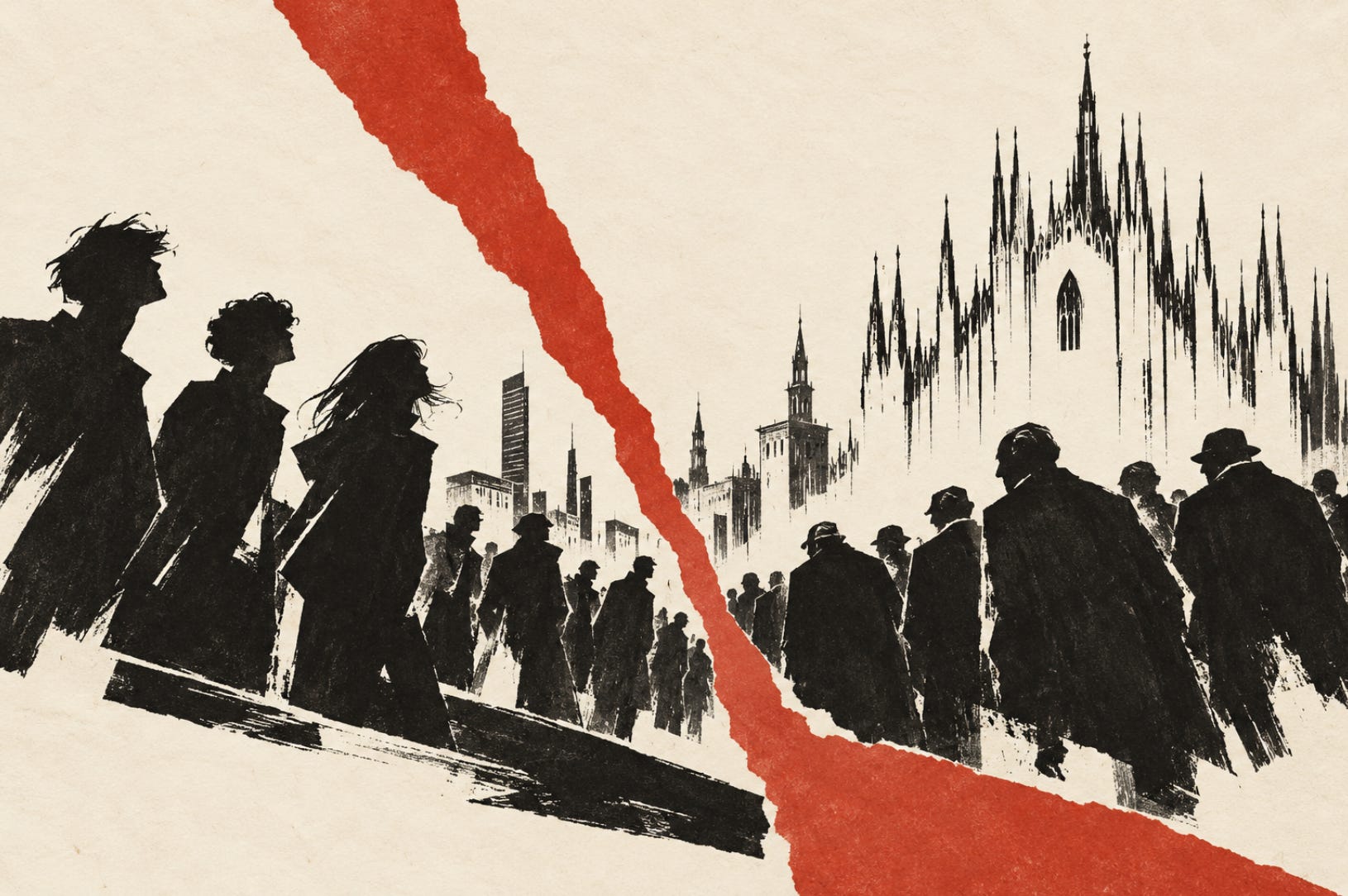
Milan likes to present itself as Italy’s city of the future: finance, fashion, international investment, gleaming architecture and opportunities that seem to stretch beyond the country’s familiar limitations. This week, a very different image of the city travelled around the world: smashed shopfronts, riot police and soldiers being sent to restore calm.
The contrast is unsettling—and worth examining beyond the images.
As The Guardian reports, demonstrations over the cost of living escalated into clashes, vandalism and looting. Italian authorities said 271 people had been detained in Milan and 32 arrested. The government announced that 500 military personnel would be sent to the city, alongside proposals for tougher security measures.
There is no reason to romanticise the violence. Destroying shops, attacking people or damaging public property is not an economic programme, and those responsible should be held accountable. But there is an equally poor reason to stop thinking once the arrests have been announced.
The Guardian notes that the violent groups emerged on the fringes of initially peaceful protests. That distinction matters. So does the wider European context: anger over fuel prices, housing costs and the prospects available to younger generations has been spilling into the streets of several countries. Italy is not an isolated case, although the specific causes and participants differ from place to place.
The deeper contradiction is visible in Milan itself. It is a magnet for ambition, but a difficult city in which to establish an independent life if earnings fail to keep pace with living costs. Its luxury storefronts project a confident global identity, while the young people outside them may experience a very different economy. None of that excuses rioting; it helps explain why a conversation confined to public order would be incomplete.
The Meloni government faces two tests at once. One is immediate: protect residents, businesses and the right to peaceful protest. The other is structural: make a credible case that a generation facing expensive housing, uncertain work and limited upward mobility has a stake in the future it is being asked to respect.
A police deployment can change what happens on a street this weekend. Whether politics can change what happens there in five years is a far more consequential question.
THE ITALIC TAKE
We Italians have become rather good at presenting Milan as a European capital of opportunity. The presentation is convincing. The rent is less so.
Violence must be stopped, and peaceful protest protected. But a city cannot measure its success only by the price of its apartments, the brands in its windows or the number of investors arriving at Linate.
If a generation believes the future belongs to everyone except them, 500 soldiers may protect the streets. They cannot sell that generation a future.
ITALIC — Set in bold. From Italy without geography.