
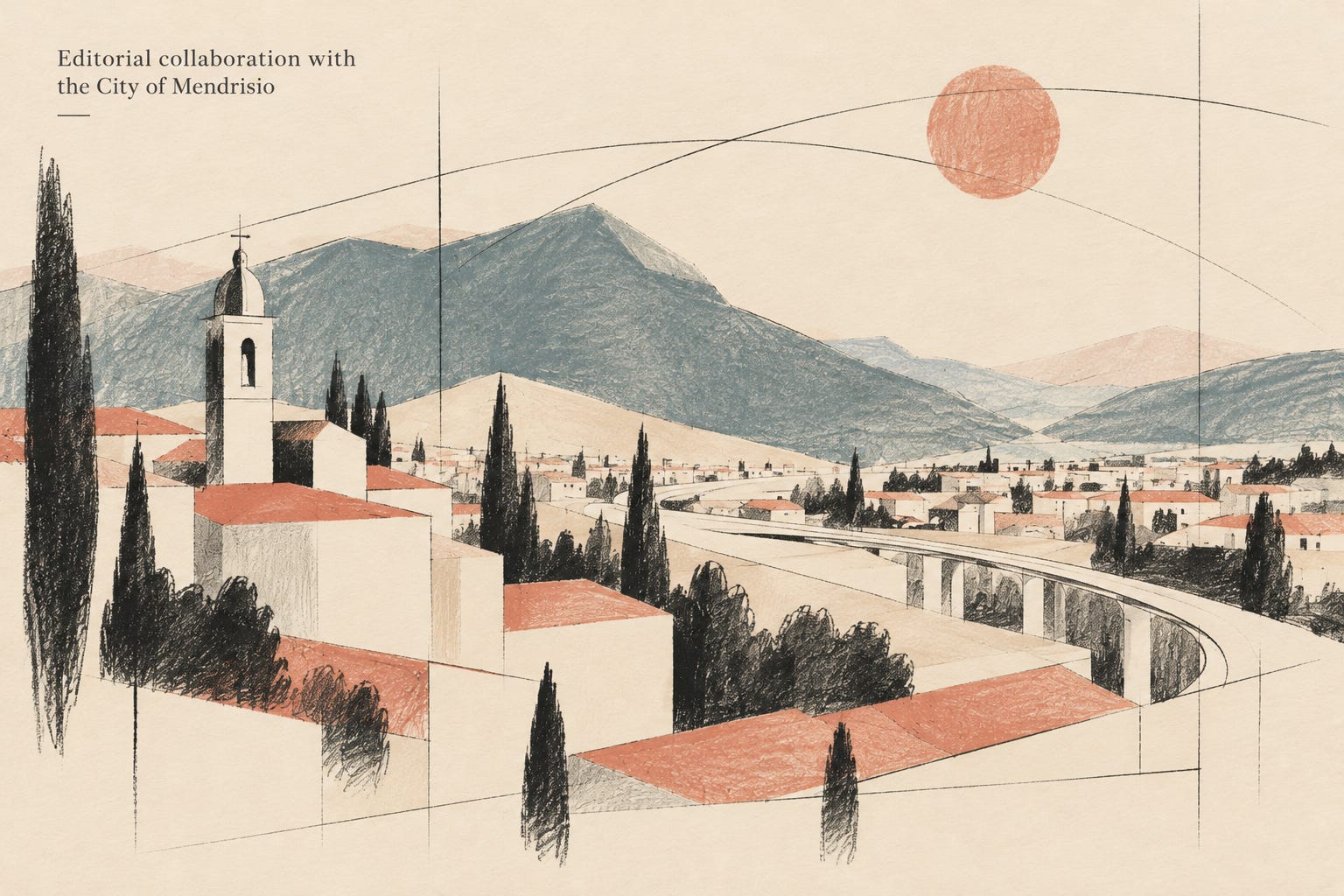
The relationship between Italy and Switzerland is often described through borders, commuting and economic differences. Yet places such as Mendrisio suggest another way of looking at this geography: as a connected territory in which work, everyday life and international opportunities increasingly overlap.
Originally published by NOMAG, this article explores why smaller, well-connected cities may offer an alternative to the traditional choice between metropolitan intensity and geographical isolation.
The idea of international mobility is often described as if it were a choice between extremes. Either the large global city, with its concentration of capital, talent, airports and noise, or the remote escape, where quality of life is measured by how far one can get from everything else.
But many professionals, entrepreneurs and internationally mobile workers are beginning to look for something more interesting than either of those options: places that are not isolated, but not overwhelmed; connected, but still liveable; close enough to major economic and professional networks to matter, yet small enough for daily life to remain manageable.
Mendrisio belongs to that category.
Its appeal is not based on the fantasy of disappearing from the world. Quite the opposite. What makes the city interesting is its position within a dense geography of relationships: Ticino, northern Italy, the Swiss economy, the Milan metropolitan area, cross-border work, education, finance, design, manufacturing, research and professional services. Mendrisio is not a place outside the map. It is a place where several maps overlap.
That may be one of the most relevant advantages for a new generation of mobile professionals. The question is no longer simply where to live, or where to work, but how to build a life that can connect different systems without being defined or constrained by them.
For years, mobility was treated mainly as speed. More flights, more relocations, more cities, more events, more movement. But a more mature version of mobility is emerging. It is less about constant motion and more about strategic access. Being able to reach the right people, markets, institutions and opportunities without necessarily living at the centre of the most expensive and high-pressure urban environments.
Mendrisio offers a useful case study because its scale and location work together. On one side, it provides the practical advantages of a smaller city: proximity, services, manageable routines, access to nature and less everyday friction than many metropolitan environments. On the other, it sits in a region where professional and economic connections are unusually dense.
This matters for people whose work is no longer tied to a single office but still depends on trust, relationships and physical presence. Remote work has not eliminated geography. It has changed how we use it. A consultant, founder, investor, researcher or senior professional may not need to commute five days a week, but still needs access to meetings, networks, clients, institutions and talent.
The most useful places, therefore, are not always the biggest. They are the places that make access easier without making everyday life heavier.
This is where Mendrisio’s positioning becomes relevant. Through Mendreasy, the City of Mendrisio presents the territory not only as a place to live, but as a gateway into a broader economic and social ecosystem. The message is not simply “come here because life is pleasant”. It is more precise: here, living, working, studying and developing an activity can become part of the same territorial ecosystem.
That distinction is important. Lifestyle alone is not enough to attract internationally mobile professionals. Beautiful landscapes and good food can start a conversation, but they rarely sustain a relocation decision on their own. People also need to understand how a place works. What it connects to. Which opportunities it opens. How easily personal life and professional ambition can coexist.
Mendrisio’s advantage is that it does not need to pretend to be Zurich, Milan or Lugano. Its role can be different: a smaller, more manageable base within easy reach of larger systems. A place where professional mobility does not have to mean permanent urban intensity. A place where being connected does not necessarily require living at the centre of everything.
This is particularly relevant for international professionals in sectors such as finance, consulting, real estate, technology, design, education and cross-border services. These are worlds in which relationships still matter, but the old geography of work is being renegotiated. The office is less absolute. The commute is less inevitable. The idea of a “base” is becoming more flexible.
A base, however, still matters.
It matters because even the most mobile people need somewhere from which to organise their lives. Somewhere practical enough for ordinary days, but connected enough for extraordinary ones. Somewhere that allows work, family, health, travel and professional ambition to coexist without turning every week into a logistical performance.
Mendrisio’s proposition, at its best, is not escapism. It is intelligent positioning.
In the previous article in this series, we looked at quality of life as invisible infrastructure: the services, mobility, public spaces and environmental policies that reduce the friction of everyday life. This final perspective adds another layer. Once a city gives people time back, the next question is what that time allows them to connect with.
For internationally mobile professionals, the answer may increasingly be found in places that combine liveability with access. Places that are not trying to become global capitals, but are smart enough to connect people to the wider system around them.
Mendrisio may be one of those places.
Information: welcome@mendrisio.ch