
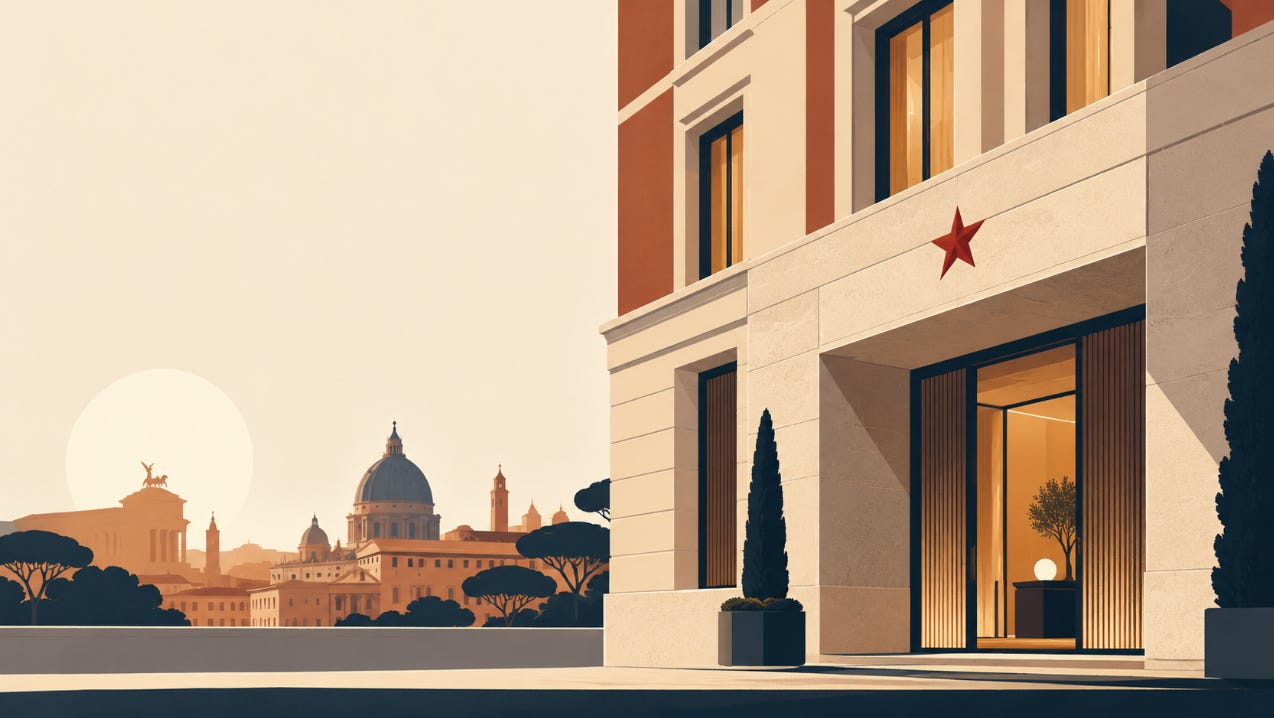
Rome has always been remarkably good at changing the purpose of its buildings without entirely erasing their past. Ancient temples became churches, aristocratic residences became public institutions, and former industrial spaces found new commercial lives. But the latest transformation in Via delle Botteghe Oscure has a particularly Italian sense of irony: a building once associated with the headquarters of the Italian Communist Party has reopened as a five-star luxury hotel.
On 27 October, Hyatt announced the opening of Thompson Rome, the brand’s first property in Italy. The hotel occupies a landmark building dating from the 1940s, just a short walk from Piazza Venezia, in a street that played an important role in the country’s post-war political history. For generations, the address was associated with party officials, political debates and decisions that influenced Italian public life. Today, its new identity belongs to international hospitality, contemporary design and luxury travel.
The contrast is striking, although the story deserves more than an easy joke about capitalism occupying the former home of Italian communism. The building’s conversion involved substantial architectural restoration, including its original marble staircase. Renovation work also brought to light a sculptural wall and an inlaid floor by Italian artist Giò Pomodoro, both concealed for decades and now incorporated into the hotel’s interiors. Rather than removing every trace of the past, the project has made elements of that history visible again.
Thompson Rome offers 69 rooms and suites, with dining spaces and a rooftop overlooking the capital. The property is owned and operated by AG Group and Rossifin Group, whose partnership combines hospitality management with investment in the building’s redevelopment. Its art collection includes works associated with the Scuola Romana and the Scuola di Piazza del Popolo, placing twentieth-century Italian creativity alongside contemporary interiors.
The opening also reflects a broader transformation taking place in Rome. International hospitality groups increasingly see the city’s historic buildings as opportunities for distinctive luxury properties, combining an established architectural identity with the services expected by wealthy international travellers. For developers, adapting an existing building can create something that a new construction could never quite reproduce: an address with its own story.
Yet adaptive reuse also raises questions about the relationship between heritage and commerce. Restoring architectural features can preserve important elements of a building, but a change in function inevitably changes its place in the city’s social life. A former political headquarters, once connected with collective organisation and public debate, becomes a private commercial destination. Both uses belong to the history of the same city, though they reflect very different moments in Italian society.
That is precisely what makes Thompson Rome interesting beyond the hospitality industry. The hotel is not simply another luxury opening in a capital already accustomed to international visitors. It is a reminder that Rome’s architectural heritage includes not only the monuments of antiquity and the Renaissance, but also the buildings that shaped Italy’s modern political and cultural identity.
THE ITALIC TAKE
There is something wonderfully Roman about the transformation of a Communist Party headquarters into a luxury hotel. The irony practically writes itself. But the more interesting question is whether a city can give its buildings new economic purposes without making their histories disappear.
In this case, the restoration has preserved some of the building’s artistic and architectural identity. That is worth recognising, even if the transformation also reflects the increasingly commercial uses of historic urban spaces.
Rome has never been a frozen museum. Its extraordinary survival depends partly on its ability to adapt. The challenge is making sure that, when a building acquires a new identity, the city does not forget the one it had before.
Even when the new guests are checking in rather than attending a party meeting.
they renovated and found a hidden art floor, every time i renovate i just find more ugly carpet under the ugly carpet