
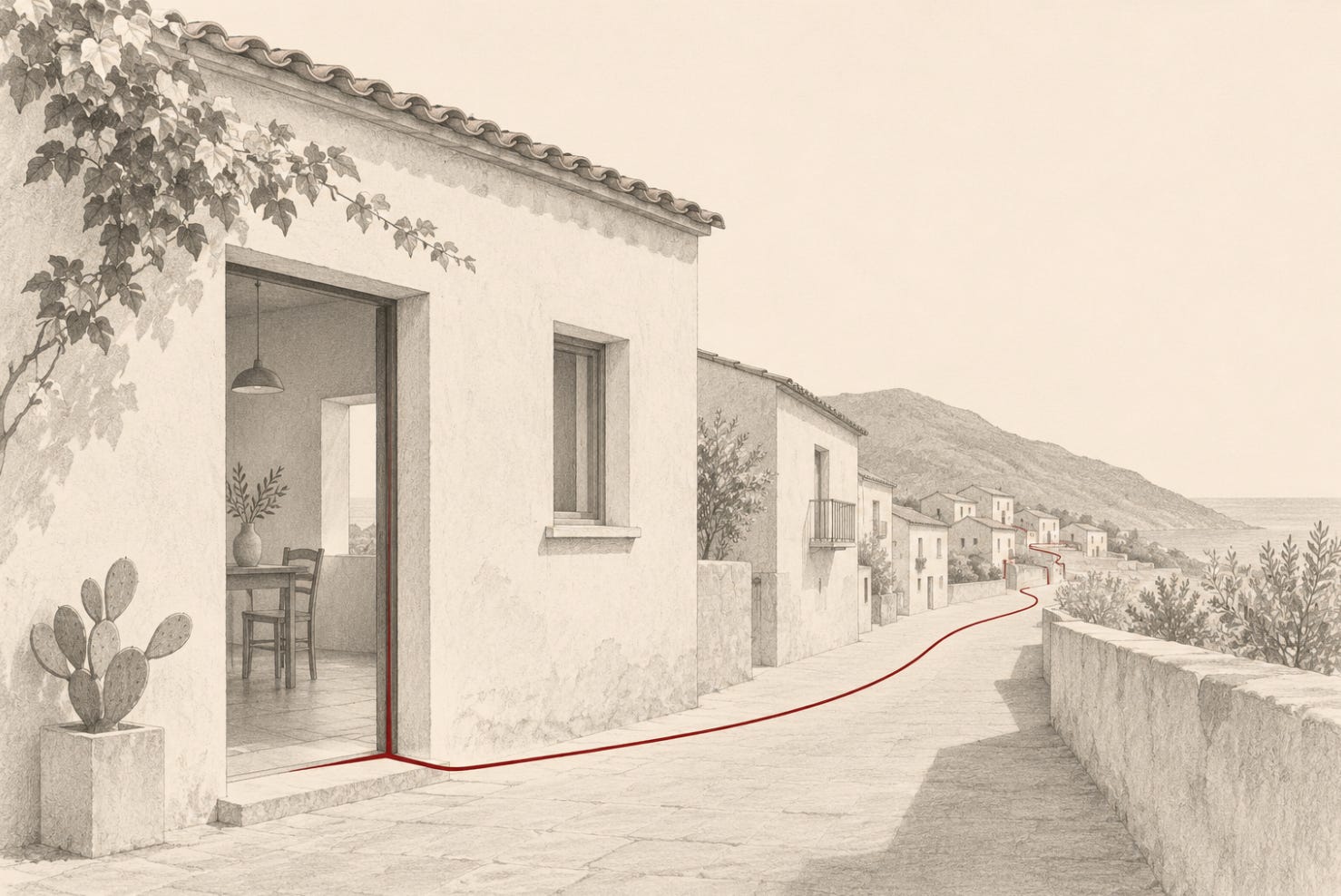
An affordable home can change somebody’s options. It can make a move conceivable, release income for other purposes and bring an unused building back into everyday life. Calabria’s new housing programme deserves to be taken seriously for those reasons. The question is how to turn that opening into a workable relationship between people and place.
The initiative has attracted international attention through The Times. Its first catalogue contains 50 public properties, to be renovated and assigned through ten-year rent-free loan-for-use agreements. Beneficiaries must maintain their residence throughout the period; applications close at 17:00 Italian time on 18 December 2026. Delivery follows rehabilitation, rather than the appearance of a property in the catalogue.
That is a substantial housing opportunity. It also places a long commitment in front of people who may still be discovering whether a particular town works for them.
The perspective developed by ITS ITALY, expressed in “Don’t Just Visit, Belong”, starts with the possibility of making Italy part of a sustainable life. A property matters enormously within that process. So do the circumstances that allow its occupants to work, build relationships and participate in the place around them.
For Calabria, this suggests a practical question: what happens between attracting an applicant and helping a household settle? Before committing, people need a credible understanding of their future week: income, schools, transport, healthcare, language and the responsibilities attached to the home. After arrival, they need somewhere to take the questions that the application form could not anticipate.
This is where the debate about inexpensive Italian houses has often become too compressed. In “Italy’s €1 houses changed the conversation. Did they change the towns?”, ITS Journal introduces Matteo Cerri’s research book Debunking Italy’s €1 House Effect. It distinguishes attention, transactions, completed renovations, recurring occupation and permanent residence. Those stages can influence one another, but they are not interchangeable measures of success.
Crucially, the distinction also prevents an unfair dismissal of everything short of demographic reversal. A restored home used regularly can sustain maintenance, local purchases and continuing relationships. That contribution deserves investigation in its own right. Calling it permanent repopulation would exaggerate it; calling it worthless would overlook it.
Calabria’s programme explicitly seeks sustained residence. Its performance should therefore be assessed against that objective. But the wider discussion should leave room for people whose connection develops gradually, through an initial stay, a return and eventually a more substantial commitment.
The preliminary RELOCALS findings, discussed in “They chose Italy. That does not mean they will repeat its sales pitch”, make that possibility worth examining. Among the first 103 participants, 64.1% had not originally expected to remain in Italy for so long. This purposively recruited group is not representative of all international residents. It nevertheless illustrates why a relationship with a place should not always be assumed to arrive fully formed.
These are connected perspectives, rather than independent endorsements: the books belong to NOMAG Research, developed with ITS ITALY, while RELOCALS also involves We the Italians. Their relevance here is the set of questions they bring to a housing initiative.
THE ITALIC VIEW
Calabria is creating an opportunity worth examining. A publicly supported home can remove a formidable obstacle to moving. The next task is to connect that home to a credible life project.
For ITS ITALY, belonging involves the relationship people build with a territory over time. That requires preparation, realistic expectations and support beyond the handover.
The useful ambition is therefore broader than filling properties and more precise than celebrating applications: recover homes, help people understand their choices, support their arrival and follow what happens afterwards. Measure each outcome honestly. Give the relationship time to develop.